Learning
Personal, social and emotional development
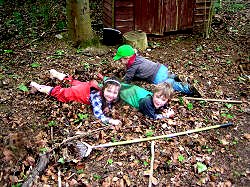
Build self esteem, independence, co-operation, team work and self confidence. Respect for living things. Sharing experiences with peers and adults. Health and safety.
Mathematical development
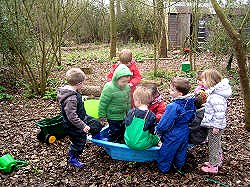
Counting natural objects. Sorting shapes, colours and sizes. Measuring, problem solving and calculating. Pattern making and recognising.
'How many children can fit in our boat?'
Physical development
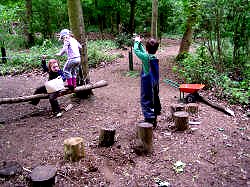
Spatial awareness, balancing, negotiating obstacles. Use of tools. Games and healthy exercise outside.
Communication, language and literacy
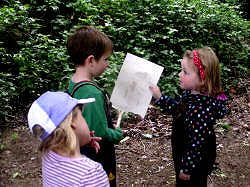
Listening to instructions, discussing findings, new vocabulary, sharing ideas, story telling, songs and rhymes. Mark making in the mud. Keeping a diary.
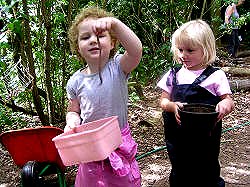
Knowledge and understanding of the world
Investigating all the natural flora and fauna in the woodland. Investigating weather, predicting and experimenting. Mapping. Growing things. Using senses to learn about materials, textures, changes etc. "Look how long my worm is!"
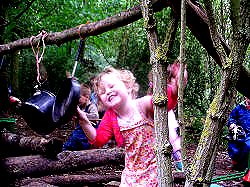
Creative development
Dancing, music making, picture making using natural materials. Mud painting. Role play and imaginative play.
Example activities
Activities may follow a group's own themes and topics or stand alone. They should always encompass individual learning styles of children and follow child centred interests where possible. All activity plans are entirely 'flexible' and often lead to unplanned experiences and learning as things are found or children lead into other areas of learning of specific interest to them.
The following two example activities can be extended or simplified to accommodate children from pre-school to key stage 1.
Activity: Elder Flower Cordial
| Collect Elder flower heads from bushes within the base area. (count 5 each). Look at leaf shape and flower head. (Adult to supervise cutting heads using small scissors) New flowers not dead. 2 small = 1 large. Follow recipe ( talk through what we would do) Stir and add water to flowers. Pour and taste what was made 4 days earlier. | Main Learning Intentions - rationale KUW - Flowers on shrubs. Mixing ingredients to make new drink. CCL - follow instructions. look at diagrams. M - comparative sizes. Counting. measuring out. C - Imagination for alternative ingredients. PSE - group work. Phy - Co-ordination. use scissors. Pouring |
| Resources: Recipe card. large mixing bowl including contents from previously made cordial less the water. baskets for collecting - scissors. wooden spoon. | Vocabulary /questions. Elder bush. parts of plant. recipe, ingredients. What does it smell/taste/look like? fridge. |
| Children for whom activity most appropriate Butterfly and caterpillar group enjoy cooking activities at playgroup and home. Bees and ladybirds may benefit from small group interaction and adult directed learning. | Group information Use groups as designated by play leader based on knowledge of individual child's needs. |
| Extension of activity. Look for other plants that will produce edible fruit later on - note their flower buds and leaves. (bramble and hazel) | Heath and safety requirements. Supervision of scissors. Stress rules about putting things in their mouths. Use wet wipes to clean hands. |
Activity: A HOUSE FOR...?
| Collect three sticks of approx same length. Suggest arm length. Construct a wigwam frame as per sheet. Demonstrate following instructions. Use scissors to cut lengths of string. Allow for flexibility and innovation, trial and error. Help when asked or offer if you feel you can extend the concentration and interest. | Main Learning Intentions - rationale KUW - nature of wood and string. CCL - follow instructions. look at diagrams. story line. M - comparative sizes. Counting. C - explore different ways to put sticks together. Imagination for uses and who will live there. PSE - group work. Phy - Co-ordination. use scissors, tying string. |
| Resources: Soft toys to suggest size and encourage enthusiasm. Accessible sticks and string of varying length and thickness. Scissors. Pieces of material and paper. Instruction sheet - wigwam. | Vocabulary /questions. Who, What and where ? open ended to promote conversation. TeePee, cone shape, tripod. Native American homes. |
| Children for whom activity most appropriate all children have shown some interest at playgroup. | information Use groups as designated by play leader based on knowledge of individual child's needs. |
| Extension of activity. Encourage small world imaginative play - collect sticks and pine cones to represent furniture etc. Decorate - gardens etc. | and safety requirements. Supervision of scissors. Correct way to carry sticks (down ward) Ensure manageable sizes of sticks. |